
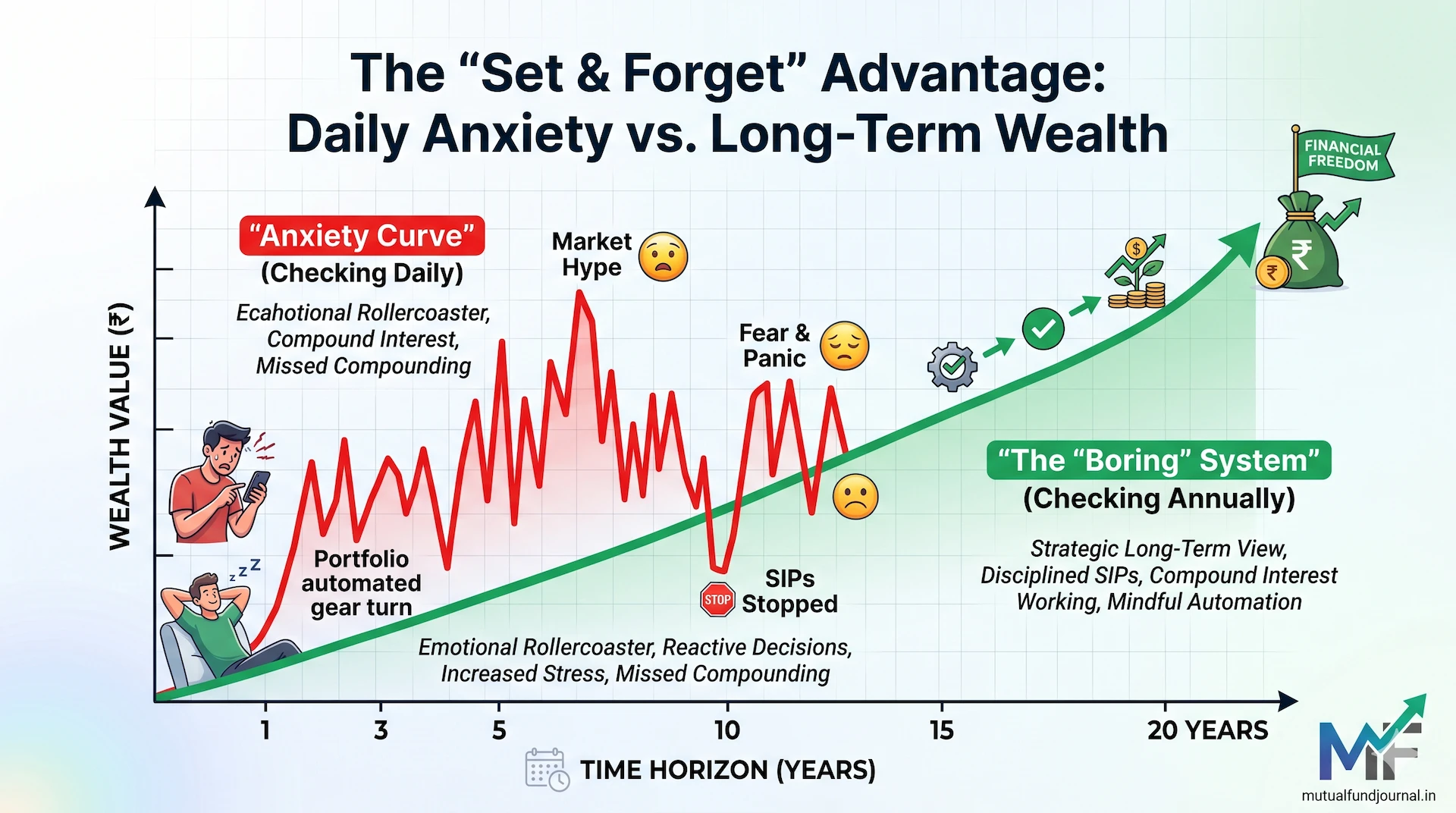
We live in an era where checking your net worth is as easy as checking your Instagram feed. Modern brokerage apps are brilliantly designed—featuring bright colors, push notifications, and real-time updates on your mutual fund Net Asset Values (NAVs).
But this gamification of investing is a trap. It turns long-term wealth building into a daily emotional rollercoaster.
When I seriously committed to building my mutual fund portfolio back in the summer of 2024, I found myself refreshing my dashboard daily. If the market was green, I felt like a genius. If the market was red, I fought the urge to pause my Systematic Investment Plans (SIPs). I quickly realized that the biggest threat to my long-term compounding wasn’t market volatility—it was my own behavior.
Here is why staring at your portfolio is actively hurting your returns, and the exact automated system I use to ignore the noise and let my money work in the background.
The Psychological Danger of the “Red Days”
Mutual funds are inherently designed for decade-long time horizons. However, human brains are wired for immediate loss aversion. When you log into your app and see your portfolio down 3% for the week, your instinct is to protect your capital.
This leads to the deadliest mistake retail investors make: stopping SIPs during market corrections.
When the market drops, your SIP is designed to buy more units at a lower NAV. By pausing your investments out of fear, you are essentially refusing to buy assets when they are on sale, severely crippling your future compounding potential.
Zooming Out: Using Macro Indicators Over Micro Checking
Instead of agonizing over the daily performance of my specific flexi-cap or index funds, I completely changed my perspective. I stopped looking at my personal portfolio and started looking at the broader market mechanics.
If you feel anxious about the market, do not look at your own money. Look at macro-level sentiment data. Tools that track objective view of the market like Fear and Greed Index:
- When the market is greedy: I know not to get overly excited or invest lump sums at market peaks.
- When the market is fearful: I am reassured that my automated SIPs are currently scooping up mutual fund units at depressed valuations.
Relying on broad market data rather than individual portfolio balances separates your emotions from your investments.
The “Set and Forget” Automation Strategy
True wealth generation should be remarkably boring. You should spend your time increasing your primary income, building businesses, or enjoying your life—not playing fund manager.
I adopted a ruthless automation philosophy to remove myself from the equation entirely:
- The Paycheck Trapdoor: My SIPs are mandated to be debited automatically exactly two days after my primary income hits my bank account. The money is invested before I ever have a chance to mentally register it as “spendable” cash.
- The App Purge: I removed all primary mutual fund tracking apps from my phone’s home screen. If I want to check my portfolio, I force myself to log in via a desktop browser. Adding this simple layer of friction reduced my portfolio-checking by 90%.
- The Annual Rebalance: I only look at my actual mutual fund performance deeply once a year. I check to ensure my asset allocation between equity and debt hasn’t drifted wildly, trim where necessary, and then ignore it for another 12 months.
Stop Trying to Outsmart the Market
The financial media relies on panic to generate clicks. Every minor dip is framed as a crisis. But if you have selected a solid foundation of diversified funds, the best thing you can do is absolutely nothing.
Set up your automated transfers, look at macro trends for educational purposes rather than emotional validation, and let time do the heavy lifting.

Leave a Reply
You must be logged in to post a comment.