
If you are serious about building a wealthy, automated life, you already know that high fees are the silent killer of compounding returns. For years, the Indian mutual fund industry operated under the Total Expense Ratio (TER) model—a single percentage that bundled management fees, operating costs, and taxes.
But as of April 1, 2026, the Securities and Exchange Board of India (SEBI) completely overhauled this system by implementing the SEBI (Mutual Funds) Regulations, 2026. This is one of the most significant regulatory shifts in decades, designed to strip away hidden charges and give you absolute clarity on what you are actually paying your fund manager.
Here is a breakdown of the new rules, how they impact your portfolio’s expense ratios, and why keeping your investment strategy simple just became even more profitable.
From TER to BER: Unbundling the Costs
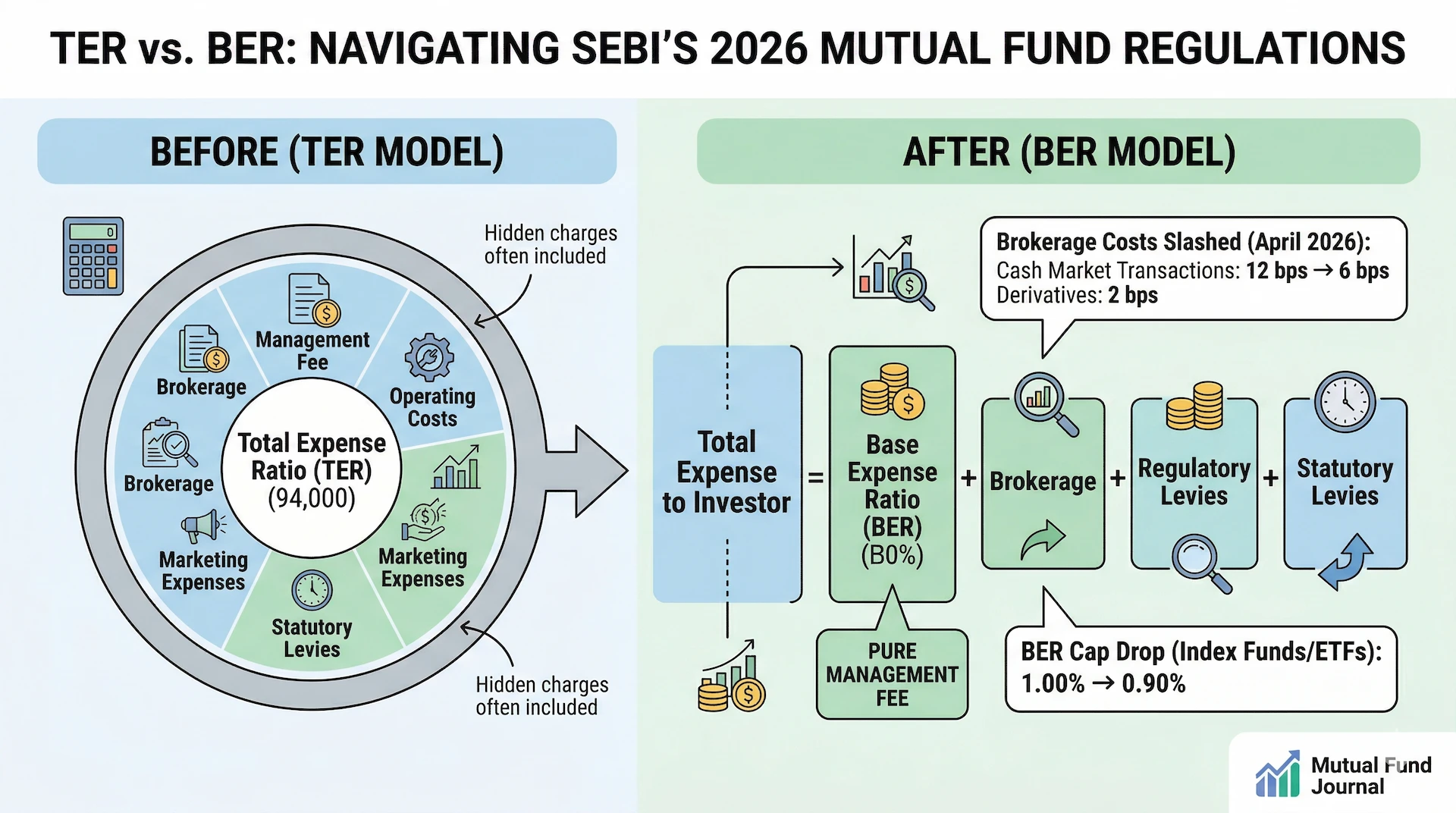
Previously, active funds could legally bury various transaction costs within a higher TER cap. Under the new 2026 framework, SEBI has replaced TER with the Base Expense Ratio (BER).
The new calculation is entirely transparent:
Total Expense = Base Expense Ratio (BER) + Brokerage + Regulatory Levies + Statutory Levies
By forcing asset management companies (AMCs) to separate the pure management fee (BER) from actual taxes and brokerage costs, the regulator has essentially stopped funds from padding their margins. Furthermore, SEBI has drastically slashed the caps on brokerage costs—dropping cash market transaction limits from 12 basis points (bps) down to a mere 6 bps, and derivative transactions down to just 2 bps.
Why This is a Massive Win for Low-Cost Investing
When you focus on living a rich life, you want your money working for you, not paying for a fund manager’s operational bloat. High expense ratios eat directly into your long-term returns, creating a massive drag on your portfolio over a 10- or 20-year horizon.
The 2026 regulations explicitly reward low-cost, diversified investing. Under the new rules, the BER limit for Index Funds and ETFs has been further reduced from 1.00% to 0.90%.
If you rely on a core portfolio of index funds, these fractional percentage drops translate to significant capital saved over your investing journey. Active funds, meanwhile, have lost their ability to charge an extra 5 bps for schemes with exit loads. The math is becoming increasingly clear: passively managed, highly diversified portfolios are not just easier to manage—they are structurally cheaper than ever before.
The Strategy Going Forward: Automate, Diversify, and Ignore the Noise
The record-breaking SIP inflows throughout late 2025 and early 2026 prove that domestic investors are waking up to the power of the equity markets. However, market exuberance often leads to portfolio clutter.
With these new regulations in place, your action plan should remain relentlessly simple:
- Audit Your Expense Ratios: Check the updated fact sheets of your existing funds. With the new BER disclosures, it is easier to see exactly what you are paying for active management versus statutory levies.
- Prioritize Broad Diversification: Do not chase narrow thematic funds just because they had a good quarter. A well-diversified portfolio across large, mid, and small caps (or a simple broad-market index) effectively reduces volatility.
- Automate the Process: Set up your monthly SIPs, ensure your asset allocation aligns with your risk tolerance, and let the market do the heavy lifting.
The 2026 regulations are a powerful reminder that in investing, what you don’t pay is just as important as what you earn. Take advantage of the new transparency, keep your expenses ruthlessly low, and stay focused on the long-term horizon.

Leave a Reply
You must be logged in to post a comment.