

Yes, you heard that right. My portfolio has just two equity funds, and I’m completely satisfied with it. A year ago, I wrote an article titled “How Many Mutual Funds Should You Have in Your Portfolio?” where I suggested that 3 to 5 quality funds were enough.
Today, I’ve refined that even further. After reading “I Will Teach You to Be Rich” by Ramit Sethi, I realized that holding a cluttered portfolio of active funds can quietly erode your wealth over the long run.
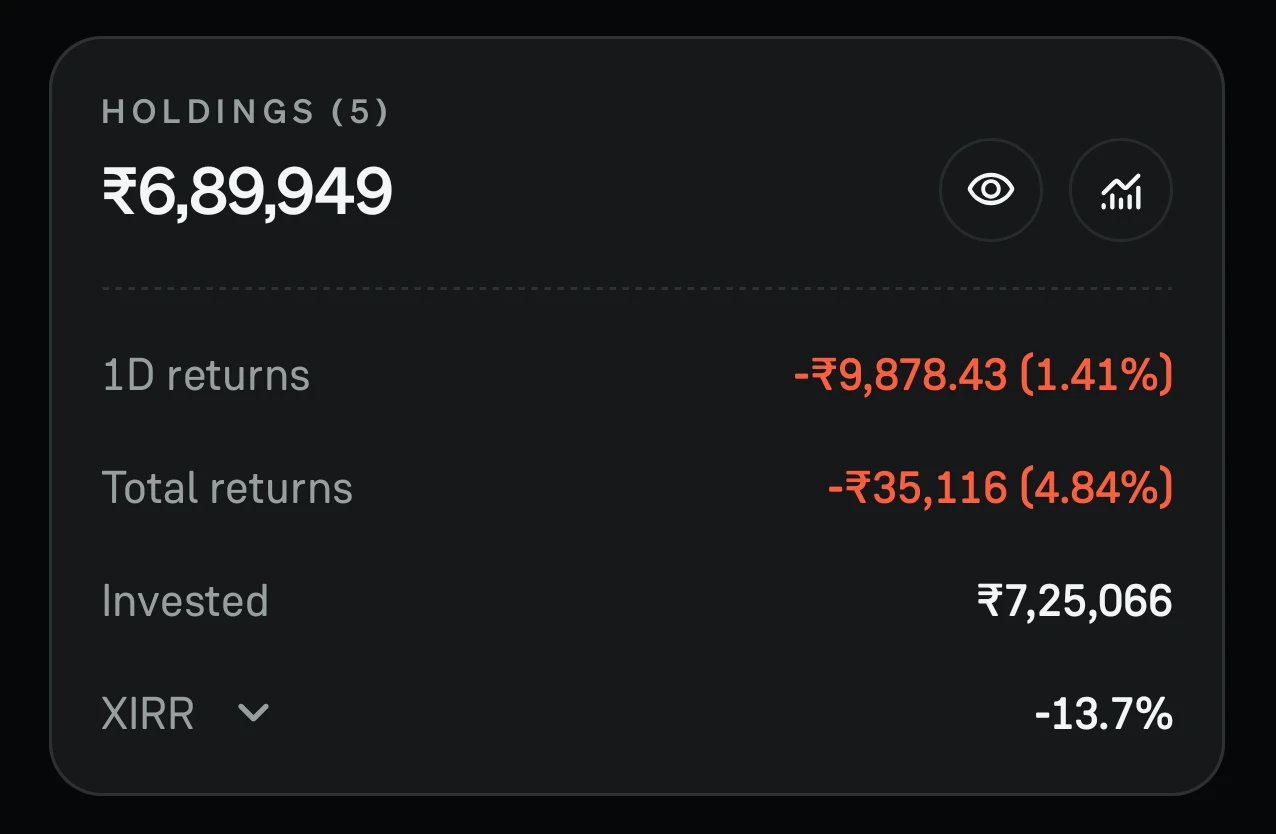
The Silent Wealth Killer: The Expense Ratio
I used to take the Expense Ratio lightly. For those who aren’t familiar, here is the simple definition: If a fund has an expense ratio of 1% and you invest ₹1 Lakh, the fund house takes ₹1,000 every year to manage your money.
They don’t send you a bill; they deduct it daily from the fund’s Net Asset Value (NAV). Whether the market goes up or down, the fund house gets paid. I realized that while I cannot control the market’s returns, I can control the fees I pay.
My “Aha!” Moment
I started investing in June 2024 with just ₹3,000. Like most beginners, I was chasing “top performers.” In 2025, I invested in a momentum fund with a high expense ratio of over 2%.
Even when the fund performed well, my net growth felt sluggish. High-churn strategies (like monthly rebalancing) often lead to higher management costs and tax implications. This led me to a hard rule: Focus on what you can control. I decided to pivot toward funds—mostly low-cost active funds—with expense ratios ideally below 0.50% to 0.90%.
The Cost of “Over-Diversification”
Many investors think holding 7 or 10 funds makes them “safer.” In reality, they are often just collecting high fees. Let’s look at a realistic comparison:
The Tale of Ram and Ramesh
Both invested ₹10 Lakh for 10 years, with the market growing at a 12% CAGR.
- Ram (The Minimalist): He invested in 3 funds. His weighted average expense ratio was low at 0.34%.
- Net Return: 11.66%
- 10-Year Value: ₹30.12 Lakh
- Ramesh (The “Over-Diversifier”): He invested in 7 funds. Because he included several expensive active funds, his weighted average expense ratio was higher at 0.80%.
- Net Return: 11.20%
- 10-Year Value: ₹28.90 Lakh
The Result: By simply choosing fewer, lower-cost funds, Ram ended up with over ₹1.2 Lakh more than Ramesh—despite them investing in the exact same market.
Conclusion
You don’t need a dozen funds to be diversified. Most “extra” funds just overlap with what you already own while charging you a premium for the privilege.
I’ve cut the noise. By sticking to two low-cost equity funds, I’m keeping my taxes low, my mental clarity high, and more of my hard-earned money in my own pocket. In the world of investing, less is almost always more.

Leave a Reply
You must be logged in to post a comment.